
Search Hilo Death Index Records
Hilo death index records are part of the Hawaii statewide vital records system maintained by the Department of Health. As the county seat of Hawaii County and the largest city on the Big Island, Hilo is also home to the Hawaii District Health Office that serves as a local contact point for residents seeking guidance on death records. This page covers every method for finding and requesting death index records connected to Hilo and the surrounding Big Island area.
Hilo Overview
Where Hilo Residents Get Death Index Records
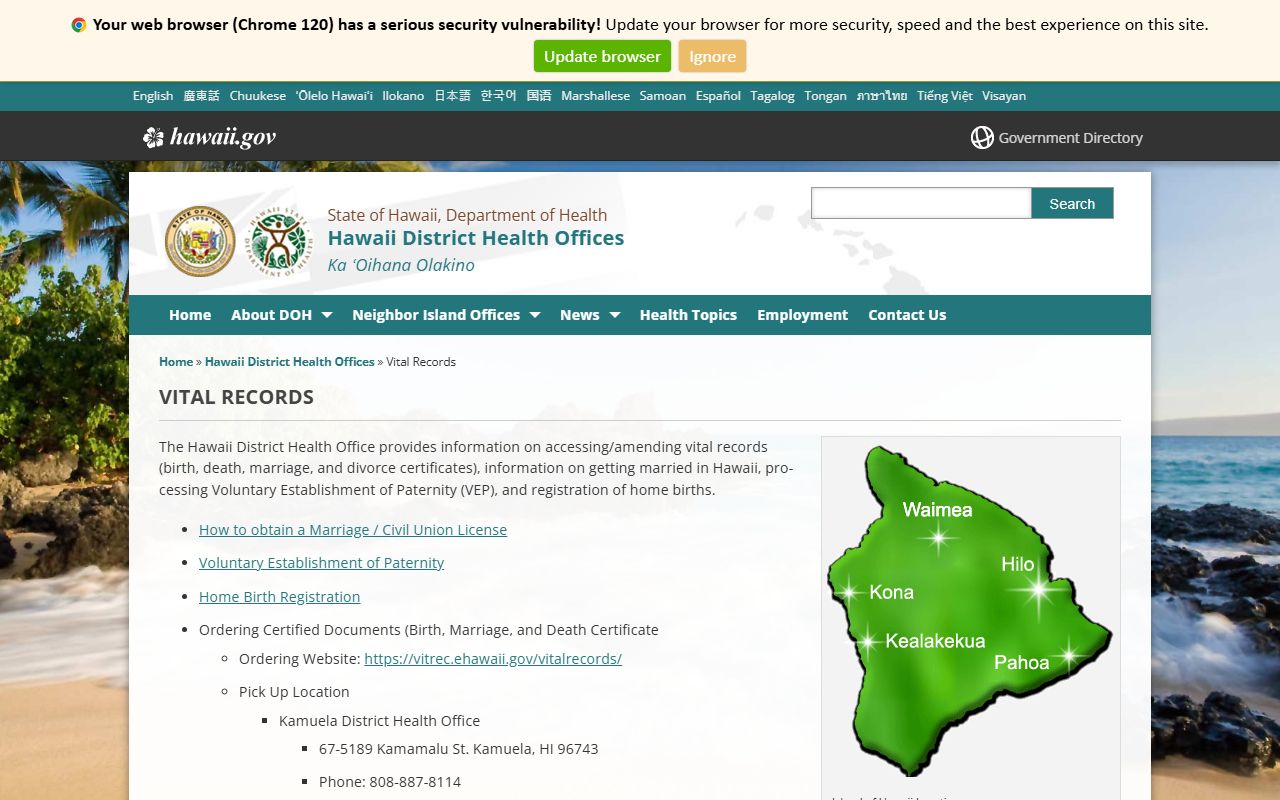
The Hawaii District Health Office in Hilo is located at 75 Aupuni Street, Suite 201. The phone number is (808) 974-6008. Staff at this office can help residents understand how to access and amend vital records, including death certificates. What the local office does not do is issue certified copies. Those come only from the state Office of Vital Statistics in Honolulu. But the Hilo district office is a good first stop if you have questions about the process or need help figuring out which documents you need before you submit a request.
Deaths that occur at Hilo Medical Center, the primary hospital on the east side of the Big Island, are filed directly with the state DOH. The state enters every death into the statewide death index, which holds the name of the deceased, age, sex, date, record type, and file number. That index data is public. Getting a certified copy requires meeting eligibility criteria under state law.

The Hawaii County Clerk office is also in Hilo at 25 Aupuni Street. That office handles county government functions but does not issue death certificates. It is not part of the vital records process.
| Detail | Info |
|---|---|
| Hawaii District Health Office | 75 Aupuni Street, Suite 201, Hilo, HI 96720 |
| Hilo Phone | (808) 974-6008 |
| State DOH Phone | (808) 586-4539 |
| Online Orders | vitrec.ehawaii.gov/vitalrecords/ |
| Mail Address | P.O. Box 3378, Honolulu, HI 96801 |
| Fee | $10 first copy, $4 each additional, $2.50 portal fee |
How to Request Hilo Death Records
Hilo residents have three main options for requesting death records: online, mail, or pickup at a nearby DOH location. Online is the fastest. The eHawaii portal at vitrec.ehawaii.gov/vitalrecords/ accepts requests any time of day, charges a $2.50 portal fee on top of the base cost, and mails the certified certificate to you. The fee is $10 for the first copy and $4 for each extra copy of the same certificate requested at the same time. Most people on the Big Island find the online path the easiest since it skips the trip to Honolulu entirely.
For those who prefer to pick up a certificate in person without traveling to Oahu, there is a pickup location in Kamuela (Waimea) at 67-5189 Kamamalu Street, Kamuela, HI 96743. The phone number there is (808) 887-8114. This location is open Monday, Wednesday, and Friday from 9:00 a.m. to 2:00 p.m. by appointment only. You must place and pay for your order online first through the eHawaii portal before you can schedule a pickup appointment at this location. Walk-ins are not accepted at the Kamuela pickup site.
Mail requests go to P.O. Box 3378, Honolulu, HI 96801. Send a completed request form, a copy of your valid ID, and payment by check or money order made out to the State Department of Health. Mail processing takes longer than online orders and there is no way to track the status of a mailed request the same way you can track an online order. If timing matters, the online portal is the better choice.
Note: The Kamuela pickup location is by appointment only and requires you to order and pay online before scheduling your pickup visit.
Third Circuit Court and Hilo Probate Records
The Third Circuit Court serves all of Hawaii County including Hilo. The courthouse is at 777 Kilauea Avenue, Hilo, HI 96720. When a person dies in Hilo and their estate has assets or debts requiring legal administration, the case goes through probate at the Third Circuit Court. Probate records are public and do not require proof of relationship to access. These files often contain death certificates, wills, lists of heirs, and court orders, and they can serve as a secondary path for finding death record information when certified copies are not directly accessible to you.
You can search for probate cases through the Hawaii state judiciary's online case management system at courts.state.hi.us. Search by the decedent's name to see whether a probate case was opened. The system will give you the case number, which you can use to request the full file. For historical Hilo deaths, the Deaths and Probates Index for the Third Circuit is held at the Hawaii State Archives and is also accessible online through Ulukau at ulukau.org. That index goes back to the 1800s and covers Hawaii Island probate proceedings from the Kingdom era onward.
Local Obituary and Burial Resources in Hilo
Hilo has several local resources that can help you find death information before, or in addition to, a formal records request. The Hawaii Tribune-Herald is the primary newspaper for Hilo and eastern Hawaii Island. Its obituary section at hawaiitribune-herald.com/category/obituaries/ publishes death notices with names, ages, dates and places of death, birthplaces, occupations, surviving family members, and funeral details. Obituaries often include the exact information you need to submit a records request, such as the full name on the death certificate, the date of death, and the place of death.
Dodo Mortuary in Hilo maintains an online obituary database at dodomortuary.com/obits with over 12,000 records going back many decades. This long-serving Hilo mortuary has served many Hawaii County families over generations, so its database covers a broad range of local deaths. The records are searchable online at no cost. Ballard Family Mortuary at ballardfamilymortuary.com is another Hilo-area funeral home that publishes recent obituaries on its website.
Homelani Memorial Park at homelanimemorialpark.com serves as one of the main cemeteries for Hilo and Hawaii County. Burial records include dates and plot locations, which can be helpful when you know a general time of death but not the exact date. Veterans who died in the Hilo area may be interred at East Hawaii Veterans Cemetery. Tribune-Herald obituaries frequently note burials at both sites, making them useful cross-references when searching the death index.
The information you need to request a death certificate from the state DOH includes the full name on the certificate, the date of death, the place of death, the name of the father, and the name of the mother. Local obituaries and mortuary records often supply most of these details, saving time when you go to submit the formal request.
Historical Death Records for Hilo
FamilySearch is a strong starting point for genealogical research into Hilo deaths. The site holds digitized Hawaii Death Records and Death Registers going back to 1841. The collection covers all of Hawaii Island and includes the Vital Statistics Collection for 1832 to 1929. These records are free to search and view. You can access them at familysearch.org without creating an account, though an account lets you save and share findings.
The Hawaii State Archives at 364 South King Street in Honolulu holds the original physical records for this period. The archives also maintains the Deaths and Probates Index for the Third Circuit, which covers Hilo and all of Hawaii County. That index is searchable through Ulukau at ulukau.org. You can also search the Digital Archives at digitalarchives.hawaii.gov, where many documents have been scanned and are viewable online.
Hawaii Community College in Hilo has a library with genealogical research databases. Staff can help with local research and point you to resources specific to Hawaii County families. For older records outside the FamilySearch collection, the library databases may cover gaps not yet digitized in the state system.
Newspaper obituary indexes also fill in the historical record for Hilo. The Hawaii State Library system holds microfilm and print indexes going back to 1836 for Oahu newspapers. For the Big Island, the Tribune-Herald archive is the primary source. Earlier Hilo-area deaths may also appear in the Hilo Tribune or Hawaii Herald, predecessor papers that are indexed in library collections.
Death Record Laws for Hilo Residents
Hawaii Revised Statutes Section 338-18 is the law that controls access to death records across the state, including in Hilo. The law splits records into two categories. Public index data is open to anyone. This includes the name, age, sex, date of death, record type, and file number. No proof of relationship is needed for this level of access, and no fee applies for viewing the index.
Certified copies are restricted. Only certain people may get one. These include the spouse, parent, child, or sibling of the deceased; a legal guardian; an agent with written authorization; or someone with a direct and tangible legal interest, such as a beneficiary named in a will or someone claiming benefits tied to the death. Records that are 75 years old or older are open to the public with no restriction. Genealogists researching older Hilo families benefit from this rule since many Big Island death records from the early to mid-1900s now fall within the open window.
The full text of HRS 338-18 is available online. Reading the statute before you submit a request is useful, especially if your situation involves estate administration, a legal claim, or a request on behalf of another person. If you are not sure whether you qualify, the Hawaii District Health Office in Hilo can help clarify the rules. Legal Aid Hawaii can also assist Hilo residents who need help with access questions related to estate or benefit situations.
Hawaii County
Hilo is the county seat of Hawaii County. The county page covers death index resources for all of the Big Island including resources outside the Hilo area.