
Search Hawaii Death Index Records
The Hawaii death index is a statewide collection of death records maintained by the Hawaii Department of Health, Office of Health Status Monitoring. Anyone who needs to search for a death record, request a certified copy of a death certificate, or trace family history through official state records can use this guide to find the right office, understand what records are available, and learn how to get them. Death records in Hawaii date back to 1853, and the state offers both in-person and online options for accessing the death index.
Hawaii Death Index Overview
Where Hawaii Death Index Records Are Kept
The Hawaii Department of Health holds all official death records for the state. The central office, called the Office of Health Status Monitoring, is located at 1250 Punchbowl Street, Room 103 in Honolulu. This is where all death certificates are filed, stored, and issued. The office operates Monday through Friday from 7:45 a.m. to 2:30 p.m. and is closed on state holidays. Metered parking is available out front at $2 per hour, payable by cash or credit card.
The Hawaii Department of Health death certificates page explains the full process for ordering a certified copy. You can reach the office by phone at (808) 586-4539 or by email at doh.issuanceQuery@doh.hawaii.gov. For neighbor island residents, the state also maintains district health offices on each island. Hawaii Island residents use the office at 75 Aupuni Street, Suite 201 in Hilo, phone (808) 974-6008. Maui County residents contact the Maui District Health Office at 54 South High Street, Room 301 in Wailuku, phone (808) 984-8210. Kauai residents call the Kauai District Health Office in Lihue at (808) 241-3498.
The Hawaii State Archives at 364 South King Street in Honolulu holds a separate collection of historical death records. The Archives is the place to go for genealogical research on records older than 75 years. It also holds probate records, court records, and newspaper obituary indexes going back to 1836.
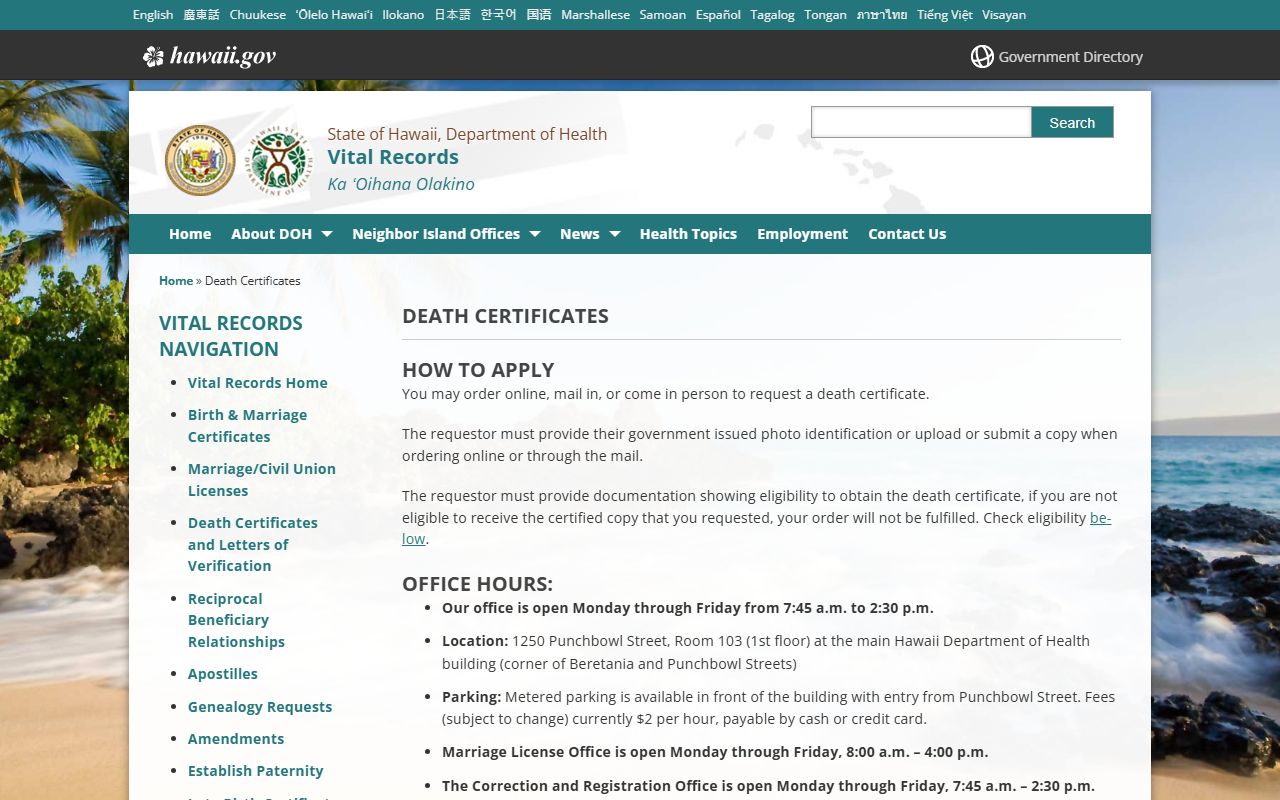
The DOH death certificates page is the starting point for most death index requests in Hawaii, with step-by-step instructions for online, mail, and in-person orders.
How to Search the Hawaii Death Index
Hawaii provides several ways to search for a death record. The fastest method is online through the state's eHawaii vital records system. The eHawaii Vital Records ordering system lets you request certified copies of death certificates for deaths recorded from July 1909 to the present. The system performs exact name matches, so you need to enter the name exactly as it appears on the certificate. A free account lets you track order status and simplify re-orders.
To search for a death record online, you need the full name on the certificate and the date of death in MM/DD/YYYY format. The system also requires you to upload a copy of your government-issued photo ID and documents showing your relationship to the deceased. All uploaded documents are stored encrypted and deleted one year after the order date. Files must be GIF, JPG, PNG, or PDF format under 10MB.
Mail orders are also accepted. Send your request form, a copy of your photo ID, proof of relationship, and a cashier's check or money order to: State Department of Health, Office of Health Status Monitoring, P.O. Box 3378, Honolulu, HI 96801. Cash and personal checks are not accepted by mail. The current processing time for mailed requests is 6 to 8 weeks.
The CDC's Where to Write for Vital Records guide for Hawaii is a useful reference that outlines the process and directs you to the right office. The CDC guide notes that some records go back as early as 1853, making it one of the longer-running death record systems in the country.
Request a Certified Hawaii Death Certificate
Certified copies of Hawaii death certificates cost $10.00 for the first copy of each certificate. Each additional copy of the same record ordered at the same time is $4.00. A $2.50 portal administration fee applies to online orders for each group of up to 5 copies. Online orders accept credit or debit cards only. If the record is not found, the $10.00 fee still applies as a search fee. All transactions are non-refundable.
Not everyone can get a certified copy. Access is limited to people with a direct and tangible interest in the record. That includes the person listed on the record, their spouse, their parents, their descendants such as children and grandchildren, siblings, grandparents, aunts, uncles, cousins, legal guardians, estate representatives, and people acting on the person's behalf. A court order can also grant access. If you cannot show a qualifying relationship, you will not receive a certified copy, but you may still be able to get a verification letter.
Verification letters are a different option. They confirm that a death certificate exists on file with the Department of Health and can verify basic information you already know. Letters cost $5.00 each and are only available by mail or in person, not online. They use the same eligibility rules as certified copies.
For in-person requests at the Honolulu office, bring your government-issued photo ID, proof of your relationship to the deceased, and payment in cash, cashier's check, or money order. Appointments are encouraged but walk-in service is available between scheduled appointments.
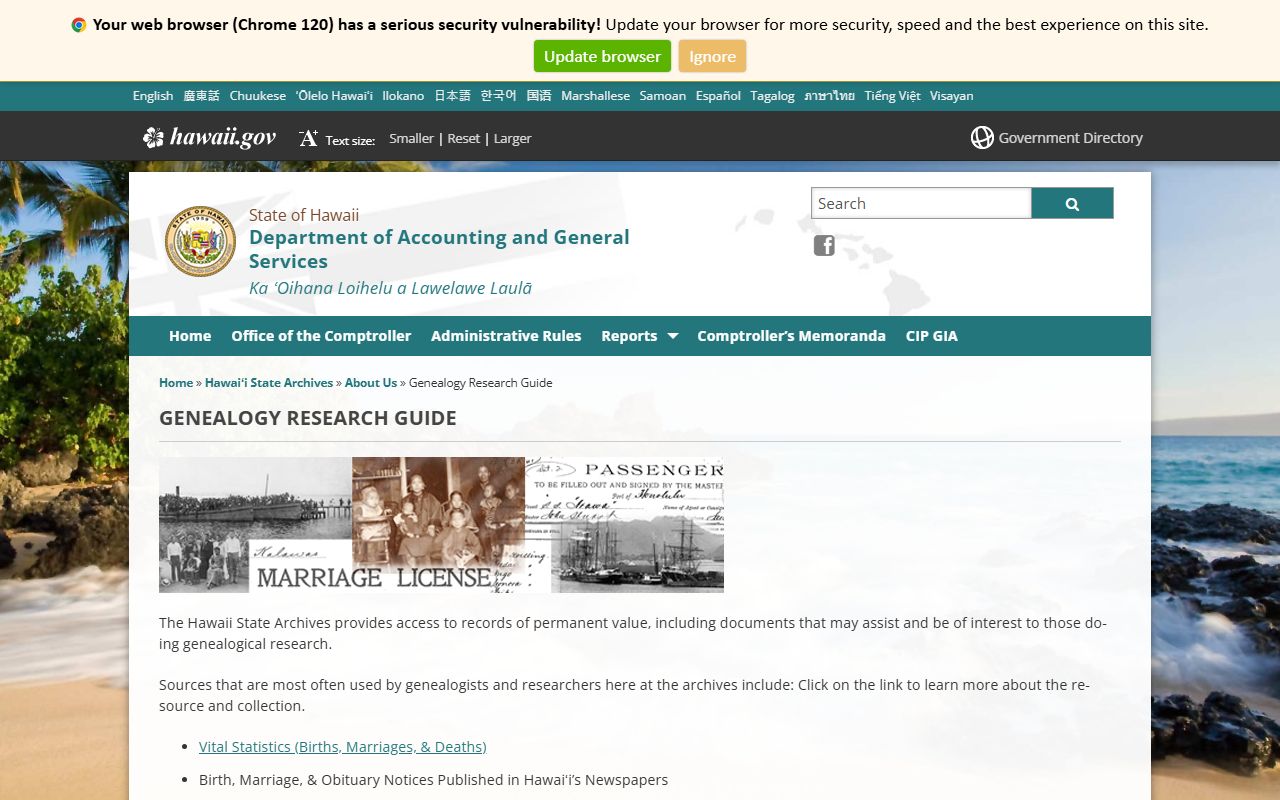
The Hawaii State Archives genealogy guide walks researchers through the sources available for death records, probate records, and newspaper obituary indexes dating back over 150 years.
Historical Death Records and Genealogy Research
Hawaii's death registration history is long but uneven. Statewide registration of deaths began in 1859. Few records exist until 1896, and general compliance with death registration was not achieved until 1929. The state holds some records going back to 1853. For researchers working with older records, the Hawaii State Archives and several digital databases provide access to historical death indexes and related records.
The Hawaii State Archives Digital Archives holds microfilmed vital statistics records including the Vital Statistics Collection which covers births, marriages, and deaths from 1832 to 1929. The reference system uses a letter code for each island: H for Hawaii Island, K for Kauai, M for Maui, and O for Oahu. Once you find an index entry, you can use the volume and page number to locate the full record on microfilm.
The Digital Archives project provides long-term online access to historical Hawaii government records, including the Vital Statistics Collection that covers death registrations through 1929.
The Ulukau Hawaiian Electronic Library provides access to genealogy indexes compiled from Hawaii State Archives records. These cover deaths and probate records through wills and estate filings, divorce case files, marriage records from 1826 to 1929, and citizenship records. The indexes are organized by judicial circuit, so knowing the island where the death occurred helps narrow the search. If an indexed entry lacks a linked digital image, check the Hawaii State Archives Digital Archives to see if the record was digitized.

Ulukau is the starting point for many Hawaii genealogy searches, holding indexes to probate and will court records, divorce case files, and death-related records from the 19th and early 20th centuries.
The University of Hawaii at Manoa Library's Hawaii Genealogy Research Guide is another useful starting point. The guide covers the Vital Statistics Collection, the Hawaiian Genealogy Indexes at Ulukau, and the State Archives' Index to notices of births, marriages, and deaths in Hawaii newspapers from 1836 to 1950. This newspaper index covers notices published in the Pacific Commercial Advertiser, Honolulu Advertiser, Hawaiian Gazette, Friend, Independent, Ka Hae Hawaii, Polynesian, and Honolulu Star-Bulletin. The index was originally a card file, has since been microfilmed, and is partially searchable online through FamilySearch.
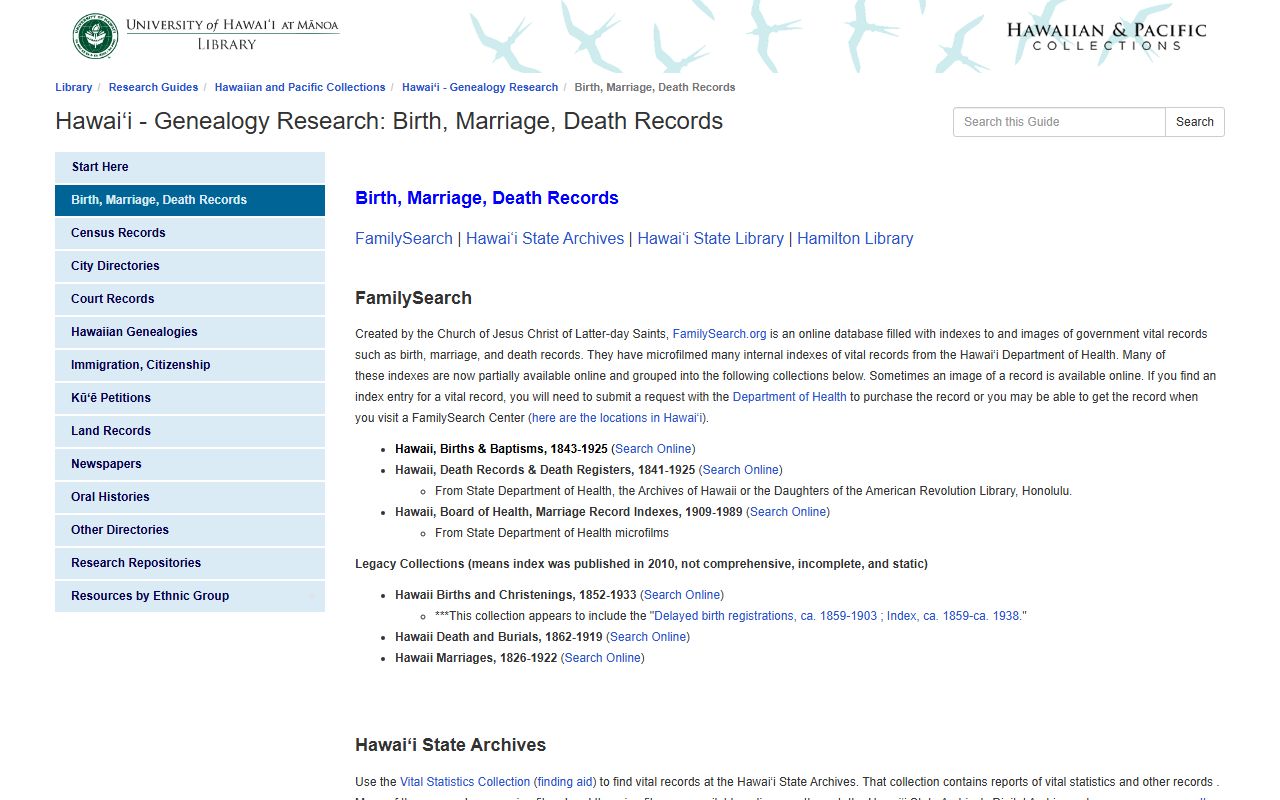
The UH Manoa library guide is a well-organized entry point for anyone beginning genealogical research into Hawaii death records, with links to both digital and physical archive collections.
Hawaii Death Data and Vital Statistics
The Hawaii Health Data Warehouse tracks annual death statistics for the state. Death certificate data comes from the Office of Health Status Monitoring and includes the date, time, location, and cause of death for every death that occurs in Hawaii. Cause of death is determined by a physician, advanced practice registered nurse, medical examiner, or coroner, and coded under International Classification of Diseases, 10th Revision rules. Hawaii recorded 12,883 deaths in 2024 and 12,751 in 2023. The state had 9,632 deaths in 2010, showing consistent growth over the past 15 years.
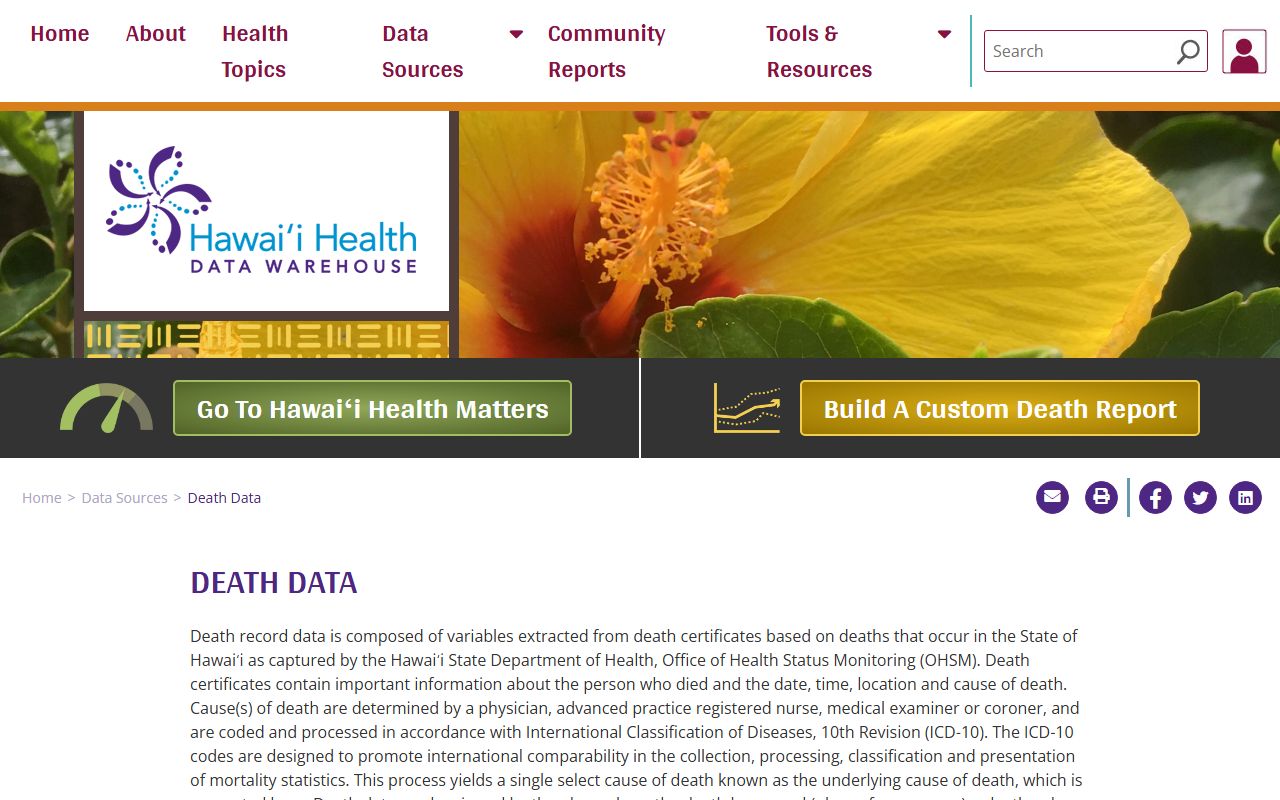
The Hawaii Health Data Warehouse publishes annual death counts and cause-of-death statistics, providing a public health perspective on the state's mortality trends going back to 2000.
The CDC WONDER database gives researchers access to Hawaii mortality data at the federal level. You can query death counts by age, sex, race, geographic area, and cause of death. The system pulls from the National Vital Statistics System which aggregates death certificate data from all states including Hawaii.
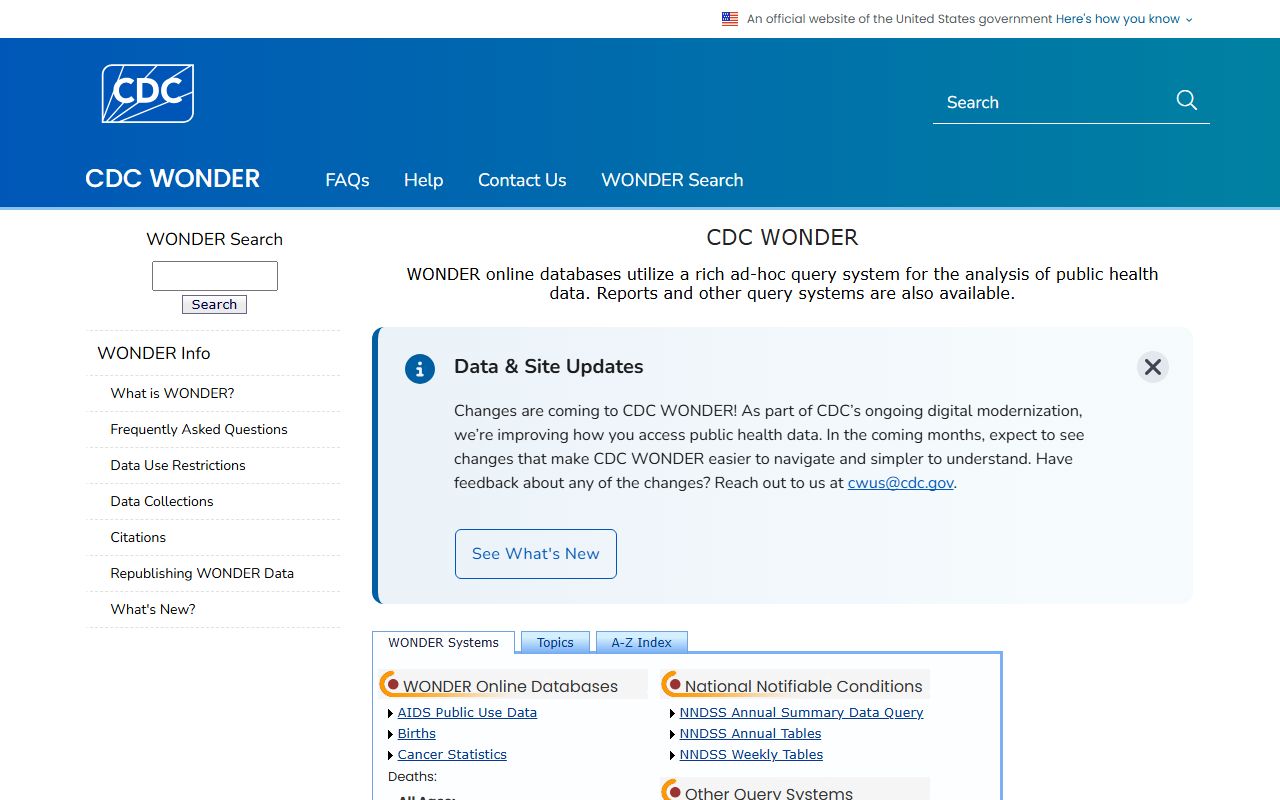
CDC WONDER lets researchers query Hawaii death data by demographic and geographic variables, drawing from the same national vital statistics system that collects data from Hawaii's Office of Health Status Monitoring.
Hawaii Death Record Laws
Hawaii's vital records system runs under Hawaii Revised Statutes Chapter 338, titled Vital Statistics. This chapter sets up the state's system for registering, maintaining, and disclosing vital records. Section 338-8 makes death registration compulsory. Section 338-9 requires the person in charge of disposition of a body to file a death certificate with the Department of Health or the local district agent within three days of death. Section 338-14.5 sets the fee at $10 for the first certified copy and $4 for each additional copy ordered at the same time.
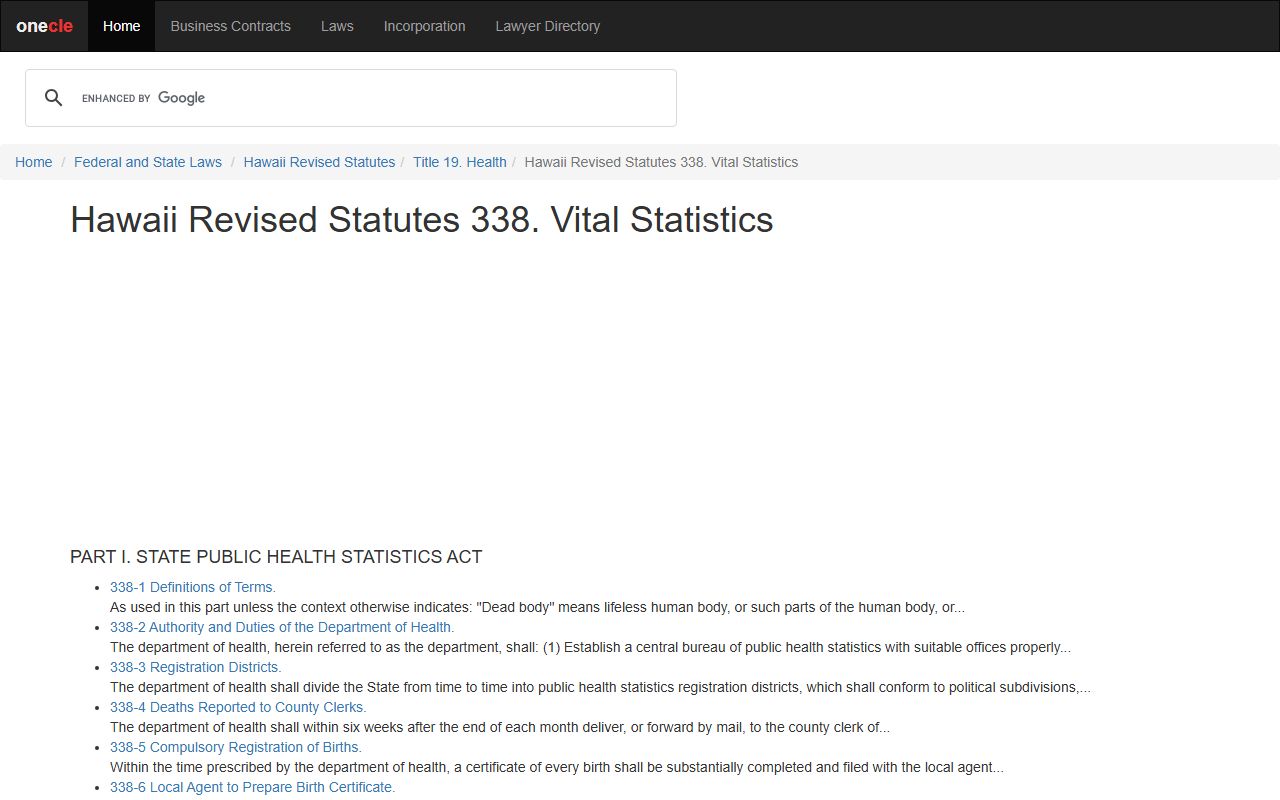
HRS Chapter 338 is the full legal framework behind Hawaii's death registration system, covering everything from the form of certificates to the fees charged for certified copies.
Hawaii Revised Statutes Section 338-18 governs who can access death records. It is unlawful to inspect, copy, or disclose information from a death certificate unless the applicant has a direct and tangible interest in the record. The statute lists eligible parties: the person named in the record, their spouse, parents, descendants, siblings, grandparents, legal guardians, estate representatives, and others with a specific legal need. Section 338-18 also creates a public access rule: index data consisting of name, age, sex of the registrant, and date, type, and file number of the vital event can be made available to the public. This is the Hawaii death index in its public form.
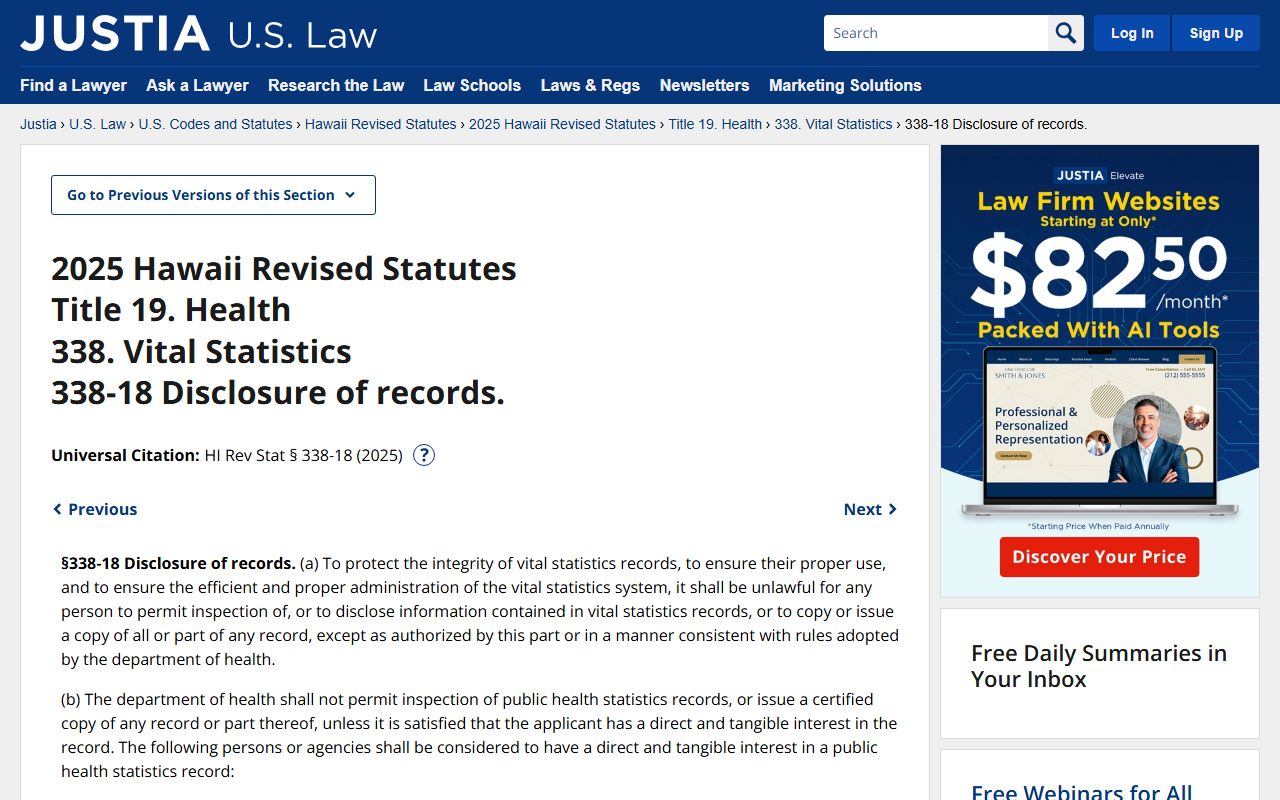
HRS 338-18 is the statute that defines exactly who qualifies for a certified copy, how index data may be released to the public, and when records become fully open after 75 years.
One key rule under HRS 338-18 is the 75-year provision. Death certificates that were filed more than 75 years ago are no longer confidential. They become available to the public for genealogical research. Section 338-18 also permits people working on genealogy projects to access microfilm or other copies of vital records from events more than 75 years in the past, even if they do not have a direct family connection. This makes the Hawaii State Archives an especially useful resource for anyone researching ancestors who died before the 1950s.
Section 338-4 of the HRS requires the Department of Health to deliver monthly death lists to each county clerk. These lists contain the names of all citizens of voting age whose deaths were recorded during the prior month. The county clerks use these lists to update voter registration rolls.
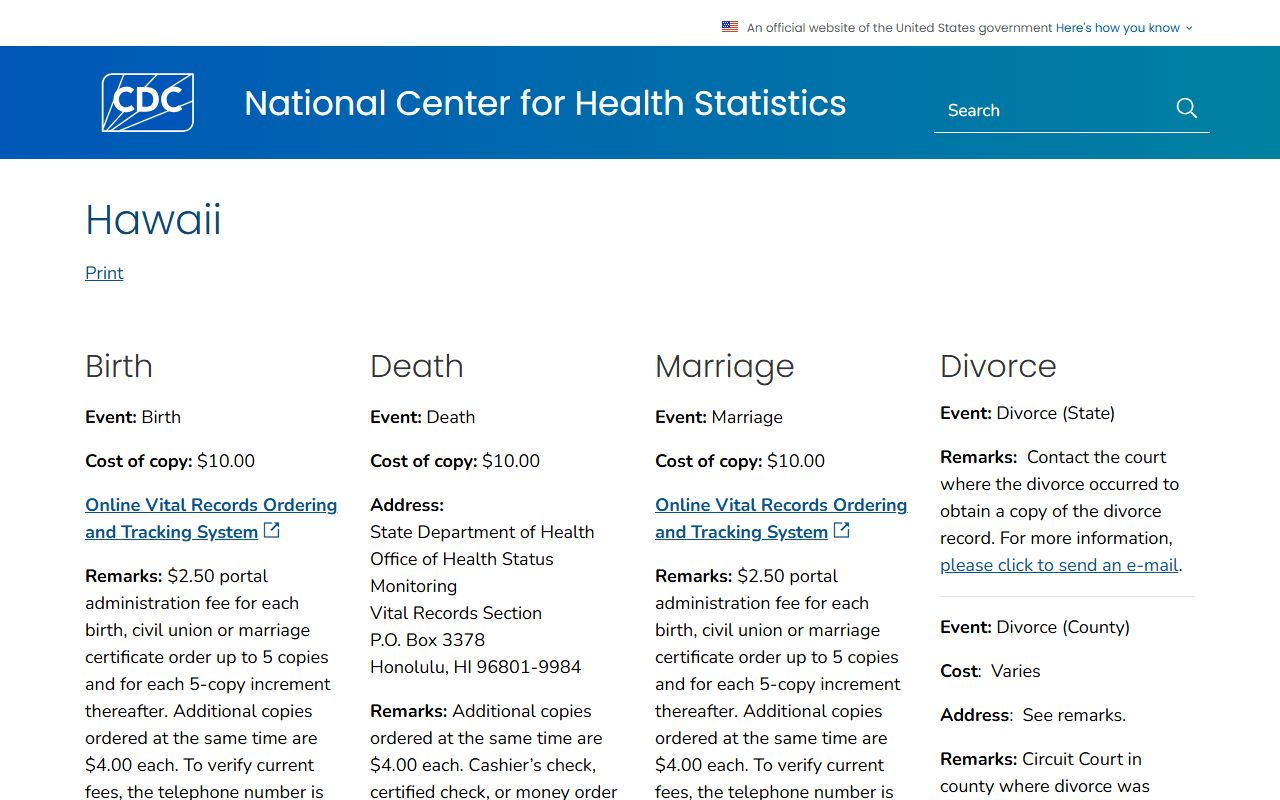
The CDC's vital records directory for Hawaii confirms the state office address, current fees, and the telephone number for fee verification at (808) 586-4533, which provides recorded information about current costs.
Hawaii State Archives and Probate Records
The Hawaii State Archives holds several collections directly useful for death research. These include the Vital Statistics Collection covering records from 1832 to 1929, the Index to Obituary Notices in Hawaii newspapers from 1836 to 1950, and Deaths - Probates Index for each of the state's five judicial circuits. The probate indexes cover the First Circuit (Honolulu), Second Circuit (Maui), Third Circuit (Hawaii Island), and Fifth Circuit (Kauai). Probate records often contain death dates, family relationships, and property information not found on a death certificate alone.
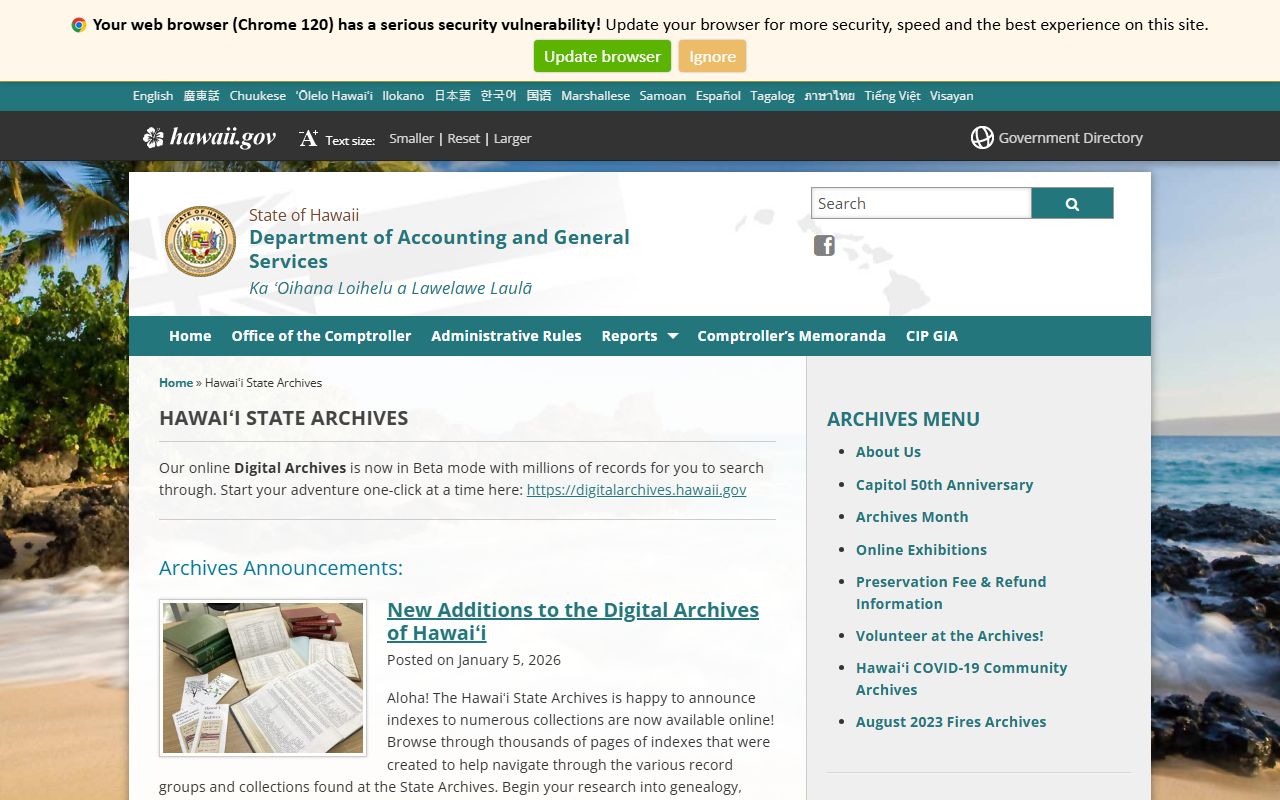
The Hawaii State Archives at 364 South King Street in Honolulu is open to the public and provides free interpreter services for those who need assistance in another language by calling (808) 586-0400.
The Archives also maintains Marriage Record Indexes available online, using a reference system with a letter for the island, a volume number, and a page number. While the Marriage Indexes are fully searchable online, other vital records collections require a visit to the Archives or use of the Digital Archives system. Researchers who find an indexed entry without a linked digital copy should check the Digital Archives first and then contact the Archives directly if the record is not there.
Browse Hawaii Death Index by Location
Counties
Hawaii has five counties. Each one has a district health office and circuit court that handle death records and related matters at the local level.
Cities
Major communities across the Hawaiian Islands each have local resources for searching death records and accessing the state vital records system.