
Mililani Town Death Records
The Mililani Town death index covers residents of this central Oahu planned community within the City and County of Honolulu. Hawaii's state vital records system handles all death certificate requests, and this page explains where to look, what to request, and how to find older records through archives and court indexes.
Mililani Town Overview
Accessing Death Index Records in Mililani Town
Mililani Town has no local vital records office. There is no city clerk or county health branch in the community itself. All death records for Mililani Town residents are filed with and maintained by the Hawaii State Department of Health, which operates a statewide vital records system. This is how it works for every community on Oahu, not just Mililani Town.
The Hawaii DOH Vital Records office is at 1250 Punchbowl Street, Room 103, Honolulu. Walk-in hours run Monday through Friday from 7:45 a.m. to 2:30 p.m., and the office closes on state holidays. That is a drive of roughly 20 miles from central Mililani Town, which is why most residents choose to use the online system or mail instead. Phone inquiries go to (808) 586-4539, and email questions can be sent to doh.issuanceQuery@doh.hawaii.gov.
The online portal at https://vitrec.ehawaii.gov/vitalrecords/ is the most convenient way to order a certified death certificate for a Mililani Town resident. It is available around the clock and does not require a drive to Honolulu. For the death index itself, which includes name, age, sex, date of death, type of death, and file number, the public index data is searchable without needing a certified copy at all.
The Hawaii State Archives and the Ulukau Hawaiian electronic library hold older death index records that pre-date the current online system. If you are looking for a death from many decades ago, those sources may be the right starting point rather than the DOH portal.
How to Request a Death Certificate
Certified death certificates are not the same as death index data. The index is a public summary. A certified copy is the full legal document, and access to it is restricted. Only people with a direct and tangible interest in the record can get one. That generally means the spouse, parent, child, sibling, or legal representative of the person who died. Researchers and the general public do not qualify for certified copies unless the record is at least 75 years old.
Mililani Town residents who need a certified death certificate have three ways to request one. Online ordering through the eHawaii portal is the fastest and most convenient route. A $2.50 portal fee applies on top of the record fee. Mail requests go to P.O. Box 3378, Honolulu, HI 96801; processing by mail takes about 6 to 8 weeks. In-person requests at the Punchbowl Street office are possible during walk-in hours, though the drive from central Oahu adds time to the process.
All requests require a government-issued photo ID and proof of your relationship to the deceased. The fee is $10 for the first certified copy and $4 for each additional copy of the same certificate ordered at the same time. These fees are non-refundable even if the record is not found; a $10 search fee still applies. Plan ahead if you are on a deadline.
| Online Portal | vitrec.ehawaii.gov/vitalrecords/ |
|---|---|
| Walk-In Address | 1250 Punchbowl St., Room 103, Honolulu, HI 96813 |
| Mail Address | P.O. Box 3378, Honolulu, HI 96801 |
| Phone | (808) 586-4539 |
| Hours | Mon-Fri, 7:45 a.m. to 2:30 p.m. |
| First Copy Fee | $10 (plus $2.50 portal fee online) |
| Additional Copies | $4 each (same certificate) |
| Mail Processing Time | 6-8 weeks |
The Hawaii DOH vital records page at https://health.hawaii.gov/vitalrecords/ has the current forms, fee schedules, and detailed instructions for all request types. Check there for any updates before you submit.
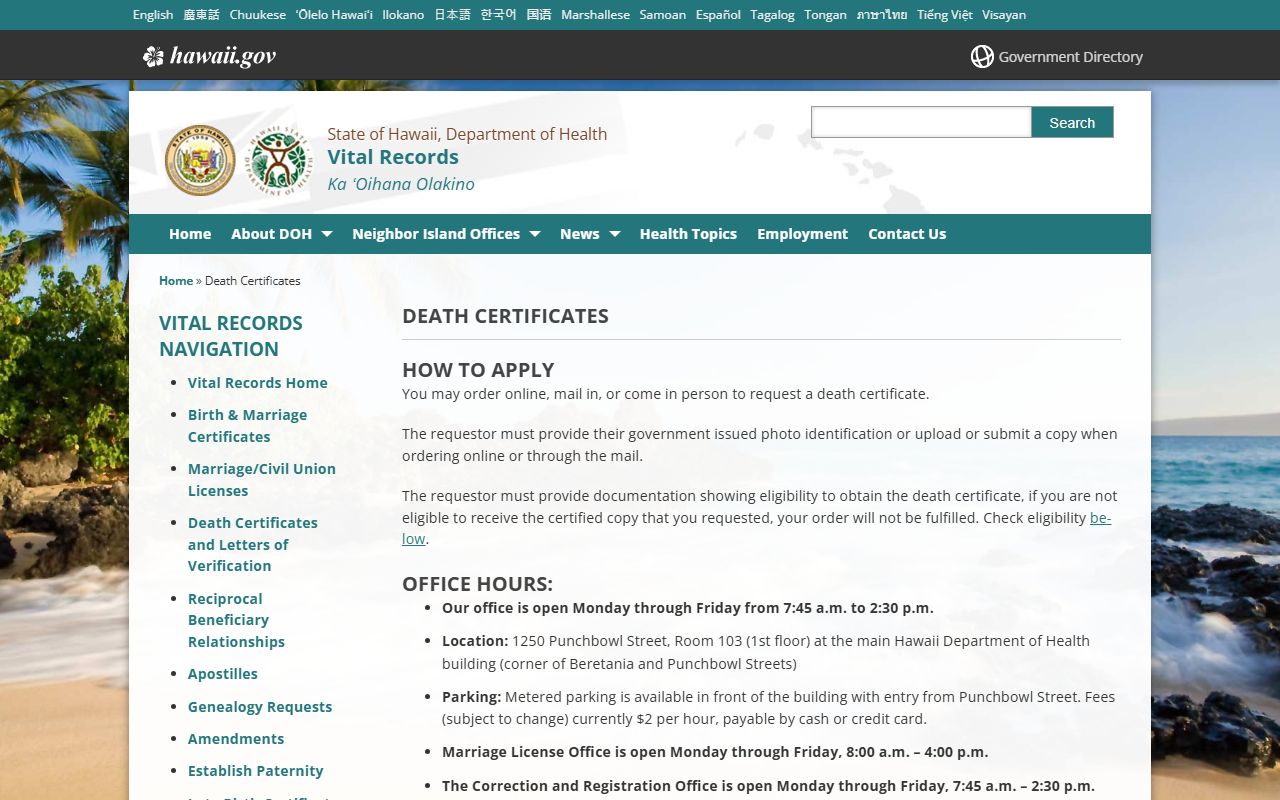
The portal above is where Mililani Town residents order certified death records online. It is the same system used by residents across all of Oahu.
First Circuit Court and Probate Records
When someone dies in Mililani Town and leaves an estate, the family or executor often needs to open a probate case. Probate for all Honolulu County residents, including those in Mililani Town, is handled by the First Circuit Court at 777 Punchbowl Street, Honolulu, HI 96813. The court's website at https://www.courts.state.hi.us/ has docket search tools and general guidance on the process.
Probate records are useful for death record research because they typically reference the date of death, the decedent's full name, and surviving family members. If you cannot find a death record through the DOH index, a probate file may fill in the gap. Older probate indexes covering Oahu are also available through the Ulukau First Circuit database, which catalogs historical death and probate records going back many decades.
Estate work often requires a certified death certificate as part of the filing package. Courts will not accept photocopies or printouts from online databases. Request the official document from DOH before starting the probate process to avoid delays.
Local Resources for Mililani Town
The Mililani Public Library is the primary local resource for Mililani Town and the adjacent Mililani Mauka community. The library provides computer access that residents can use to reach the eHawaii vital records portal, search genealogical databases, and browse the Hawaii State Digital Archives. Library cards are free for Hawaii residents. Staff can point you toward print genealogy guides and microfilm collections that may include older death records for central Oahu.
Mililani Memorial Park and Mortuary is another key resource for identifying death dates and related details for Mililani area residents. Mortuaries keep their own records of services they have provided, and those records sometimes include death dates, next-of-kin contact information, and burial or cremation details that do not appear in the public death index. Reaching out to the mortuary directly can be useful when a death index entry is hard to locate or when you need additional context about a specific case. Obituary records published through funeral homes are also searchable through some online genealogy platforms.
Note: Mortuary records are private business records and are shared at the discretion of the funeral home, not mandated by public records law.
Historical Death Records and Genealogy
Mililani Town as a planned community dates from the 1960s, but the broader central Oahu region has a much longer recorded history. For deaths that occurred before the current DOH vital records system was fully digitized, the best sources are the Hawaii State Archives and the Ulukau Hawaiian electronic library.
The Hawaii State Archives at 364 South King Street, Honolulu, holds original death registers, probate indexes, and obituary collections for Oahu going back to the 19th century. The archives are open to the public, though some materials require advance appointments. Their website at https://ags.hawaii.gov/archives/ has a research guide and contact information for the genealogy staff.
The Hawaii Digital Archives at https://digitalarchives.hawaii.gov/ provide free online access to scanned historical documents, including some death-related records from the territorial period. Many of these can be searched without visiting the archives in person, which makes them a good first stop for historical research on Mililani Town and surrounding communities.

The Ulukau First Circuit database at http://ulukau.org/ includes a Deaths and Probates Index for the First Circuit, which covers all of Honolulu County including Mililani Town. These are historical indexes, not current records, but they are valuable for genealogists tracing family lines across multiple generations. The data is free to browse and does not require registration.
FamilySearch also maintains a growing collection of Hawaii death records, including indexes contributed by volunteers and compiled from state and county sources. Searches on FamilySearch are free. Some results link to scanned images of original registers; others show transcribed index entries only. Cross-referencing multiple databases often produces the most complete picture of a person's death record history.
Death Index Access Laws for Hawaii
Hawaii law sets clear rules about who can see what in the death record system. The key statute is Hawaii Revised Statutes Section 338-18. This law divides death records into two categories: public index data and restricted certified copies.
Public index data includes the name of the deceased, age, sex, date of death, type of death, and file number. Anyone can access this data. You do not need to be a relative, and you do not need to explain your reason. This is the portion of the death record that is freely searchable through online indexes, state archives, and databases like Ulukau.
Certified copies of full death certificates are a different matter. Only those with a direct and tangible interest may request them. That means close relatives, legal representatives, and others who can document a legitimate need. The DOH verifies identity and relationship before issuing any certified copy. False claims on a vital records request are a criminal offense under Hawaii law.
Records that are 75 years old or older become public for genealogical research purposes. Once a death record crosses that threshold, any person may request a certified copy regardless of their relationship to the deceased. This rule makes older records much more accessible to family historians and researchers working on long-range genealogical projects. If you are tracing a family member who died before 1950, the full record is likely open to you.
Note: The 75-year public access rule applies based on the date of death, not the date the record was filed.
Nearby Cities
These nearby Oahu communities also have death index resources and county pages that may be relevant to your research.
Mililani Town County
Mililani Town is part of the City and County of Honolulu, which administers the First Circuit and oversees all county-level services for central Oahu.