
Kalawao County Death Records Index
Kalawao County holds one of the most distinctive sets of death index records in the entire United States, shaped by more than a century of history at the Kalaupapa leprosy settlement on Molokai. This page explains where those records are held, how to request death certificates tied to Kalawao County, and where to find historical death registers and genealogy resources covering everyone from early patients to modern residents of the settlement.
Kalawao County Overview
About Kalawao County and Its Unique Death Records
Kalawao County was carved out of Maui County on April 22, 1903, to govern the Kalaupapa leprosy settlement on the north shore of Molokai. The name Kalawao means "mountain-side wild woods" in Hawaiian, a fitting name for a place cut off from the rest of the island by sea cliffs that rise a quarter mile above the ocean. Those cliffs, among the tallest in the world according to the Guinness Book of World Records, made Kalaupapa one of the most geographically isolated settlements in Hawaii. The only land route in or out runs down a mule trail through the cliffs.
The county has no independent government of its own. For nearly all administrative functions, including vital records, Kalawao County is served by Maui County. The judicial district is the Second Circuit, based in Wailuku. This means any court filings, probate records, and death-related legal matters for Kalawao County run through the Maui court system. The Second Circuit Court is at 2145 Main Street, Wailuku, and questions about court records can be directed there or to the Maui District Health Office.
What makes the Kalawao County death index truly distinct is the Kalaupapa settlement itself. From 1866 to 1969, more than 8,000 people with Hansen's disease were quarantined on this peninsula. Deaths at the settlement were recorded separately from the broader state vital records system for much of that period. Those records now form a unique historical archive that draws genealogy researchers from across the country and around the world.
Note: Kalawao County is the smallest county by population in the United States. It has no independent county government, and Maui County handles all administrative services on its behalf.
How to Find Kalawao County Death Index Records
Death certificates for Kalawao County are ordered through the Hawaii State Department of Health, just like any other county in the state. The online request portal is at vitrec.ehawaii.gov/vitalrecords. There is no local office in Kalaupapa that handles vital records. The Maui District Health Office (MDHO) at the State Office Building, 54 South High Street, Room 301, Wailuku, HI 96793, coordinates vital records questions for Kalawao County residents and can answer questions by phone at (808) 984-8210.
No pickup service exists on the Maui side for death certificates. All certified death certificates, whether for a recent death or one from decades ago, are mailed from the Office of Health Status Monitoring in Honolulu. The same standard fees apply: $10 for the first certified copy, $4 for each additional copy ordered at the same time, and a $2.50 portal processing fee for online orders. Payment goes through the online system and does not involve the MDHO directly.
Hawaii began statewide vital records registration in 1842, but consistent compliance with registration requirements did not occur until around 1929. For Kalawao County specifically, birth, marriage, death, court, land, and probate records are available from 1905. Census records start in 1910. Records before 1896 exist in very small numbers. This is worth knowing before you submit a request so you have realistic expectations about what the state system can produce for older deaths.
| Request Portal | vitrec.ehawaii.gov/vitalrecords |
|---|---|
| First Copy Fee | $10 |
| Additional Copies | $4 each |
| Portal Fee | $2.50 (online orders) |
| Records Available From | 1905 (general); few before 1896 |
| MDHO Phone | (808) 984-8210 |
| Judicial District | Second Circuit (Wailuku, Maui) |
Kalaupapa Settlement Death Records at the State Archives
The Hawaii State Archives holds several special collections tied directly to the Kalaupapa settlement and the Kalawao County death index. The most important of these is the Kalaupapa Death Register of Patients. This register documents deaths of individuals who were confined to the leprosy settlement and represents a separate, parallel record system that operated alongside the regular vital records infrastructure. For researchers tracing ancestors who were sent to Kalaupapa, this register is often the primary source.
The State Archives also holds the Kalaupapa Marriage Documents and the Kalaupapa Patient Register. The Patient Register records the arrival of individuals at the settlement, which is often the starting point for any research into what became of a particular person. These collections are part of what the Archives describes as its most valuable holdings, most of which date to the 19th century and the early period of Hawaiian government. Together, the patient register and the death register allow researchers to trace an individual from the time they arrived at Kalaupapa to the date of their death.
The State Archives is managed by the Hawaii Department of Accounting and General Services. The main website is at ags.hawaii.gov/archives. Not everything in the Kalaupapa collection has been digitized, so researchers with serious genealogical needs may need to contact the Archives directly or plan a visit to Honolulu. Staff there can confirm what is available for a specific time period or a specific name.
Note: The Kalaupapa Death Register is a separate record from standard Hawaii death certificates and covers deaths at the settlement from 1866 through 1969. It is held at the Hawaii State Archives, not at the county or district health office level.
Kalaupapa National Historical Park and Death Records
Kalaupapa was designated a National Historical Park in 1980, and the National Park Service now manages the site to preserve its heritage as a former Hansen's disease quarantine colony. The NPS website for the park is at nps.gov/kala. Access to Kalaupapa is restricted, primarily to protect the privacy and dignity of any former patients still living in the settlement. You cannot simply visit the peninsula to look at local records or gravesites without going through the NPS permit process.
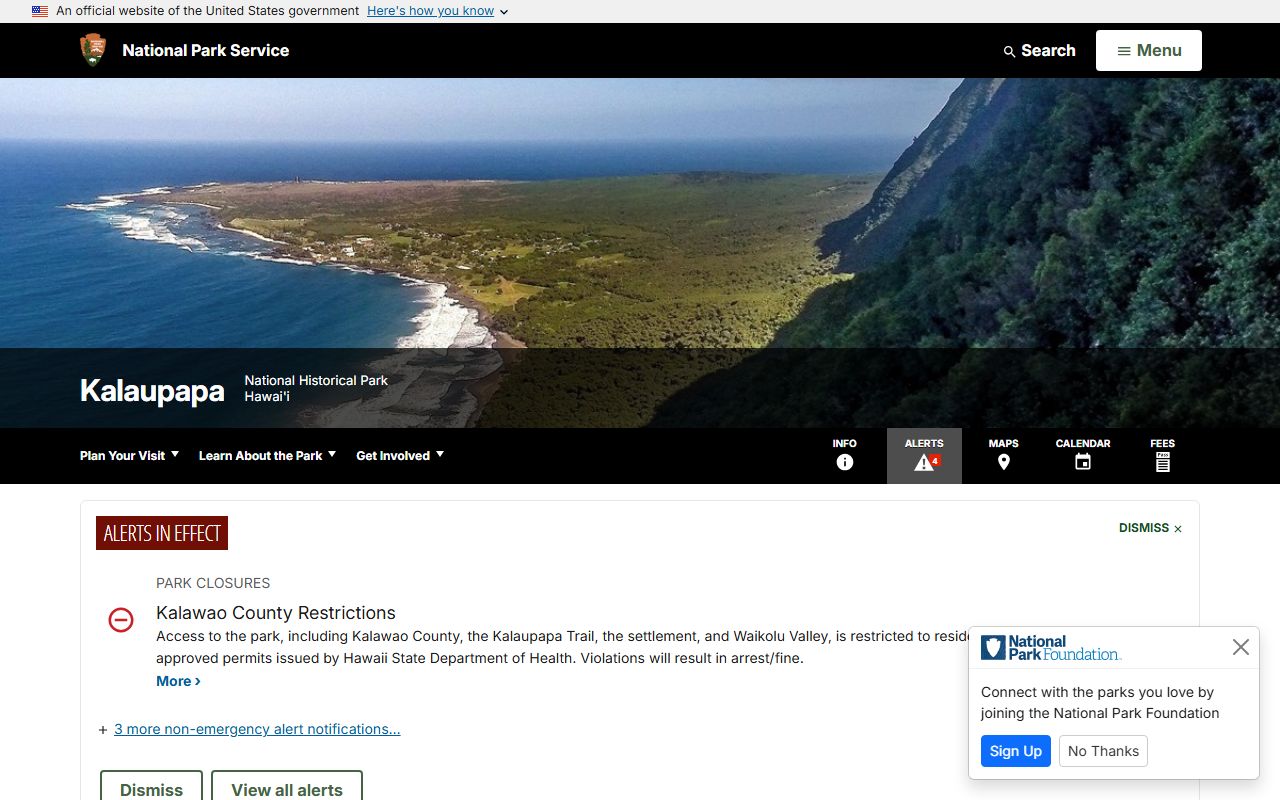
The NPS plays a meaningful role in preserving the historical context for Kalawao County death records. The settlement operated for 103 years, from 1866 when the first patients arrived, through 1969 when the quarantine was formally lifted. During that time, over 8,000 people were confined there. The historical and cultural records page for the park, at nps.gov/kala/learn/historyculture, provides background information and directs researchers toward appropriate archives and records sources. The NPS itself does not hold vital records but can point you to the right places.
Burials at Kalaupapa took place across several cemeteries on the peninsula, some affiliated with different religious communities that served the settlement. Grave markers and cemetery records can sometimes be used to confirm a death date or locate a corresponding entry in the state's death index or the special settlement registers. The NPS manages the cemeteries and can sometimes provide limited information to researchers with a documented family connection.
Historical Research Resources for Kalawao County
The FamilySearch Kalaupapa project is one of the most comprehensive digital tools for researching Kalawao County death index records and settlement history. The project is accessible through the FamilySearch wiki page at familysearch.org under Kalawao County, Hawaii Genealogy. The Community Trees section of FamilySearch includes a dedicated Kalaupapa project built to preserve and share records of patients, employees, volunteers, and kokua (the helpers and caregivers who lived at the settlement alongside patients).
The types of records incorporated into the FamilySearch Kalaupapa project include arrival records, birth records, marriage records, death records, burial records, and census population schedules. The project contains information about more than 8,000 individuals who were confined to Kalaupapa during the 103-year operation of the settlement. For most of those individuals, the death record tied to their time at Kalaupapa is the clearest surviving documentation of who they were and what happened to them. This is particularly true for people who arrived in the 19th century, when broader vital records registration in Hawaii was still inconsistent.
The Ulukau Hawaiian Electronic Library at ulukau.org holds the Deaths and Probates Index for the Second Circuit, which covers Kalawao County. The Hawaii Digital Archives at digitalarchives.hawaii.gov provides online access to some of the historical state records collections. For records that have not yet been digitized, the State Archives is the place to go. Researchers working on Kalaupapa ancestry should also check the Hawaii State DOH general vital records page at health.hawaii.gov for up-to-date information on what records are accessible and how to request them.
Note: The FamilySearch Kalaupapa project is community-contributed and covers records from the full settlement period (1866-1969). Cross-referencing with the State Archives and DOH is always a good practice before drawing conclusions from any single source.
Death Record Laws for Kalawao County
Kalawao County death index records follow the same legal framework as every other county in Hawaii. Hawaii Revised Statutes Section 338-18 governs access to all vital records in the state, including death certificates issued for deaths that occurred at Kalaupapa. The full text of HRS 338-18 sets out who qualifies to request a certified death certificate. Direct family members, legal representatives, and people with a documented legal interest in the record are eligible. Others are not, at least not for recent records.
The 75-year rule is especially relevant for Kalawao County because such a large portion of its death records are historical. Deaths that occurred 75 or more years ago are open to any member of the public. As of 2026, that means deaths before 1951 are generally accessible without proving a family connection. Given that the Kalaupapa settlement ran from 1866 through 1969, many of the most historically significant death records in Kalawao County already fall within the open-access window. You still submit a request and pay the standard fees, but you do not need to demonstrate eligibility under the restricted access rules.
For deaths within the 75-year window that you cannot access under your own eligibility, an attorney or a court order through the Second Circuit Court in Wailuku is the standard path. The Second Circuit has jurisdiction over all Kalawao County legal matters, including records access disputes. The courthouse is at the Kalana O Maui Building, 200 South High Street, Wailuku, HI 96793, and can be reached at (808) 323-4881.